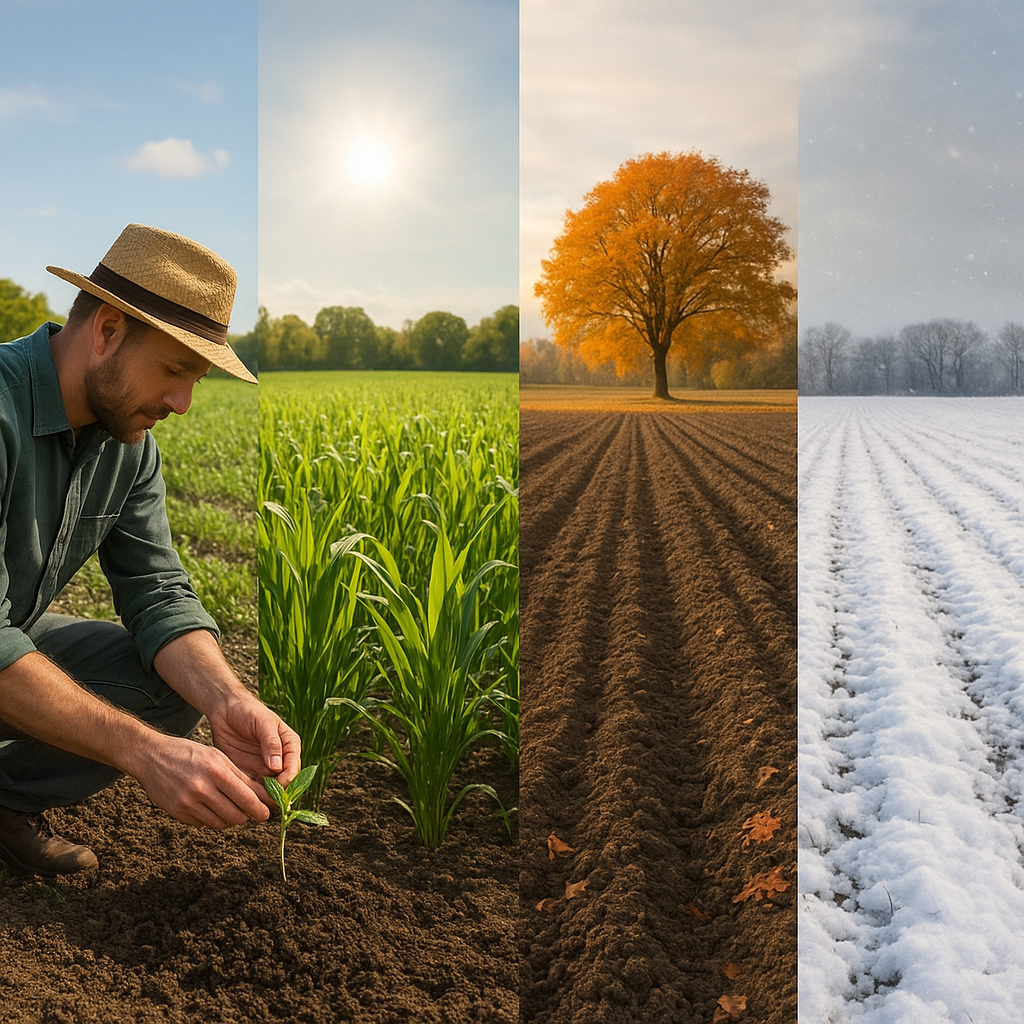
Sustainable agriculture is no longer a distant ideal; it is a practical, season‑by‑season strategy that every farm can adopt. By aligning work with natural cycles, farmers can reduce costs, protect soil health and increase resilience to extreme weather. Platforms like worldfarms.co.uk show how local conditions, crop choices and smart planning can work together throughout the year. Seasonal thinking helps optimise water, energy and nutrient use while protecting biodiversity. Instead of reacting to problems as they arise, a seasonal approach encourages long‑term planning: building **strong** soils in winter, managing **water** in spring, protecting **biodiversity** in summer and securing **soil** cover in autumn. This way, each season becomes an opportunity to maintain **resilience**, improve **productivity** and support rural **communities**.
Winter: Planning, Soil Protection and Resource Efficiency
Winter sets the foundation for sustainable success in the following year. Short days and low temperatures limit fieldwork, making it the ideal time for careful planning and assessment.
Begin with a detailed review of the past growing season. Analyse yields, pest pressures, weed problems and water usage. Compare actual results with your rotation plan and input records. This is when you can fine‑tune your crop rotation to maintain **diversity** and reduce dependency on synthetic inputs. Rotations that include legumes, deep‑rooted species and cover crops can improve soil structure and add natural nitrogen.
Soil testing in winter is especially valuable. By sampling fields and analysing nutrient levels, pH and organic matter, you can identify where **fertility** is lacking and where inputs can be reduced. Use this data to build a targeted nutrient management plan that prioritises organic amendments such as compost, manure and green manures over synthetic fertilisers. Proper planning avoids over‑application, reduces runoff and saves money.
Another winter priority is protecting soil from erosion. Bare fields are vulnerable to wind and water damage. If possible, ensure that overwintering cover crops are in place, or sow late catch crops after harvest in the previous autumn. Even light ground cover from frost‑tolerant species such as rye or vetch can stabilise soil, capture remaining nutrients and support microbial activity under the surface.
Winter is also the right moment to improve infrastructure for **water** and energy efficiency. Inspect drainage systems, repair ditches and consider installing buffer strips along watercourses. Updating or insulating irrigation lines and water storage can reduce losses in the growing season. For energy, servicing machinery, checking tyre pressure and repairing leaks all help lower fuel use during peak months.
Finally, winter is a time for learning and cooperation. Joining local groups, attending training and sharing experiences with other farmers helps spread resilient, **regenerative** techniques. Cooperation reduces the cost of specialised equipment and allows experimentation with new practices at lower risk.
Spring: Establishing Crops and Managing Water Wisely
Spring is the season of sowing and renewal, but also a period when decisions carry long‑lasting consequences. Sustainable spring practices focus on soil condition, careful planting and efficient use of available moisture.
Before entering fields, assess soil readiness. Working soil when it is too wet compacts it, destroying valuable pores that allow air and water movement. Simple tests, such as squeezing a handful of earth to check if it crumbles instead of forming a sticky ball, can prevent long‑term structural damage. Avoiding compaction supports root growth and enhances **productivity** with fewer inputs.
When choosing varieties for spring planting, prioritise traits such as disease resistance, drought tolerance and suitability to local conditions. This reduces reliance on chemical control and irrigation. Diversifying crops in both time and space—using intercropping, strip cropping or companion planting—creates a more resilient ecosystem where pests and diseases spread more slowly.
Spring irrigation strategy is critical, especially as climate patterns become less predictable. Start with practices that improve water retention rather than simply increasing supply. Maintaining surface residue, minimising tillage and using organic amendments all help soils store more moisture. When irrigation is required, consider scheduling based on soil moisture monitoring rather than fixed calendars. Drip or low‑pressure systems can significantly reduce water losses compared with overhead sprinklers.
Weed management in spring is another pillar of sustainable practice. Instead of relying solely on herbicides, use a combination of mechanical, cultural and biological controls. Adjust planting density and row spacing to shade the soil quickly. Introduce cover crops that compete strongly with weeds but support beneficial insects. Timely shallow cultivation, flame weeding in some systems and mulching with organic material can keep weed pressure manageable without degrading soil life.
In livestock systems, spring grass growth offers an opportunity to refine grazing strategies. Rotational or mob grazing, where animals are moved frequently between small paddocks, encourages uniform manure distribution, stronger root systems and improved pasture **resilience**. Planning rest periods for pastures allows plants to recover, preventing overgrazing and erosion.
Finally, spring is a good moment to establish new hedgerows, field margins and flowering strips. These elements provide **biodiversity** habitats, support pollinators and natural enemies of pests, and serve as windbreaks that protect soil and crops. Thoughtfully placed, they increase whole‑farm stability without sacrificing overall productive area.
Summer: Protecting Soil, Crops and Biodiversity
Summer concentrates the rewards and risks of farming. With rapid growth, high temperatures and variable rainfall, the focus shifts to protecting crops, maintaining soil health and preserving water supplies.
Mulching is a highly effective summer practice for maintaining **soil** moisture and temperature. Organic mulches, such as straw, composted manure or shredded plant material, shield the soil surface, reduce evaporation and suppress weeds. Over time, they break down and feed soil organisms, building **fertility**. Even in arable systems, leaving a layer of crop residue between rows or in wheel tracks can protect against crusting and erosion during heavy storms.
Summer is also peak time for integrated pest management. Rather than reacting to outbreaks with broad‑spectrum pesticides, focus on prevention and monitoring. Maintain **diversity** in and around fields to attract predators and parasitoids. Use pheromone traps, field scouting and threshold‑based decisions to determine whether intervention is truly necessary. When control is required, start with the least disruptive methods, prioritising targeted biological or mechanical options.
Efficient **water** use remains essential under summer heat. Scheduling irrigation to match plant needs—often early in the morning or late in the evening—reduces evaporation losses. In many systems, adopting deficit‑irrigation strategies, where water is supplied at slightly below full demand, can save resources without significantly reducing yields. Adjusting canopy structure through pruning or trellising can also lower water demand by reducing excessive leaf area.
Heat stress affects both crops and livestock. For animals, ensure adequate shade, clean water and good airflow in housing. Pasture planning should consider access to natural shade from trees or shelters. Agroforestry systems, combining trees with pasture or crops, are particularly useful in summer: they provide shade, improve microclimates, stabilise soils and offer an additional source of income from timber, fruit or nuts.
Harvest timing plays a critical role in sustainable management. Harvesting at optimal maturity not only improves quality but also reduces losses and waste. For cereals and oilseeds, setting machinery properly minimises grain loss and reduces the need for repeated passes that compact soil and burn fuel. For fruit and vegetables, careful picking and fast cooling protect value and reduce post‑harvest losses.
Summer is also a key period to plan for succession in the field. As early crops are harvested, consider sowing short‑season cover crops or second crops that protect the surface, fix nitrogen or break pest cycles. This keeps roots in the ground for more of the year, boosting **regenerative** processes that restore soil life and structure.
Autumn: Closing Nutrient Loops and Preparing for Rest
Autumn is the bridge between high activity and winter rest. It offers an opportunity to close nutrient cycles, stabilise soils and set up the next rotation for success.
After main‑crop harvest, evaluate residue management strategies. Incorporating residues too deeply can disrupt structure and stimulate unnecessary decomposition, releasing carbon quickly into the atmosphere. Maintaining partial surface cover, combined with shallow incorporation where needed, supports soil organisms while preventing erosion. Balancing carbon‑rich residues with nitrogen‑rich materials helps decomposition proceed without depleting available nutrients for the next season.
Autumn is the prime season for establishing cover crops in many climates. Mixtures that include legumes, grasses and brassicas bring multiple benefits: natural nitrogen fixation, deep rooting that loosens compacted layers and strong ground cover that prevents winter erosion. Carefully choosing species suited to local temperatures and moisture conditions improves the chances of good establishment and high **productivity** in the following crops.
Livestock integration can greatly enhance nutrient cycling in autumn. Allowing animals to graze crop residues or dedicated forage crops recovers value from plant material that might otherwise be wasted. Their manure returns nutrients to the soil, reducing fertiliser needs. However, grazing must be managed carefully to avoid over‑trampling wet soils, which can damage structure as winter rains arrive.
Autumn is also a practical time to improve field access and layout. Repairing tracks, adjusting gateways and planning traffic lines can limit compaction in high‑risk areas. Designing permanent wheelways in controlled‑traffic systems keeps heavy machinery on the same paths, preserving the remainder of the field in better condition for roots and soil life.
Finally, use autumn to review your economic and environmental performance. Calculate input costs, yields and margins per field or enterprise. Consider where **resilience** improved or where vulnerabilities appeared, such as crop failures due to drought or pest outbreaks. This reflection feeds directly back into winter planning, strengthening the seasonal cycle of learning and adaptation.
Year‑Round Principles for Sustainable Farming
Although tasks change with the seasons, several principles apply all year and link individual actions into a coherent, sustainable system.
First, maintaining living roots in the ground for as many months as possible drives **regenerative** soil processes. Roots exude carbon compounds that feed microbes, which in turn improve aggregation, nutrient cycling and water storage. Whether through main crops, undersowing or off‑season covers, continuous root presence is a powerful tool for building long‑term fertility.
Second, reducing soil disturbance preserves structure and biology. Minimising deep ploughing, using shallow cultivation where necessary and experimenting with direct drilling all help maintain habitat for earthworms and microorganisms. Healthier soil biology supports better nutrient use, reduces erosion and raises natural **resilience** against stress.
Third, system **diversity**—in crops, livestock, habitats and markets—buffers against shocks. Mixed farms that combine arable crops, forage and animals often cycle nutrients more efficiently and withstand price swings better than highly specialised operations. On the landscape scale, patches of woodland, grassland, hedgerows and wetlands form a mosaic that supports pollinators, predators and decomposers.
Fourth, efficient resource use underpins the economic sustainability of any farm. Monitoring energy consumption, water use and input application allows gradual improvements. Simple records, paired with regular evaluation, reveal where small adjustments can deliver large savings. Over time, these habits strengthen both environmental and financial performance.
Finally, collaboration and knowledge exchange are essential. Sustainable agriculture evolves constantly as new techniques emerge and climate, markets and policy change. Sharing information, joining cooperatives and engaging with advisory networks helps farmers test innovations safely and adapt them to local realities.
By aligning practices with seasonal rhythms and following these year‑round principles, farms can become more productive, more **resilient** and more supportive of the communities and ecosystems around them. Each season then becomes not just a challenge to survive, but an opportunity to deepen the **sustainability** of the entire agricultural system.